
Fog, mist and haze all do the same favour for a landscape: they strip out detail and leave shapes behind. Photographers tend to use the three words interchangeably, which is a pity, because they behave differently in front of a lens. Knowing which one you're standing in tells you how to expose, where to focus and what to keep.
Three Words, Three Different Things
Meteorologists separate them mainly by visibility and by what's actually floating in the air.
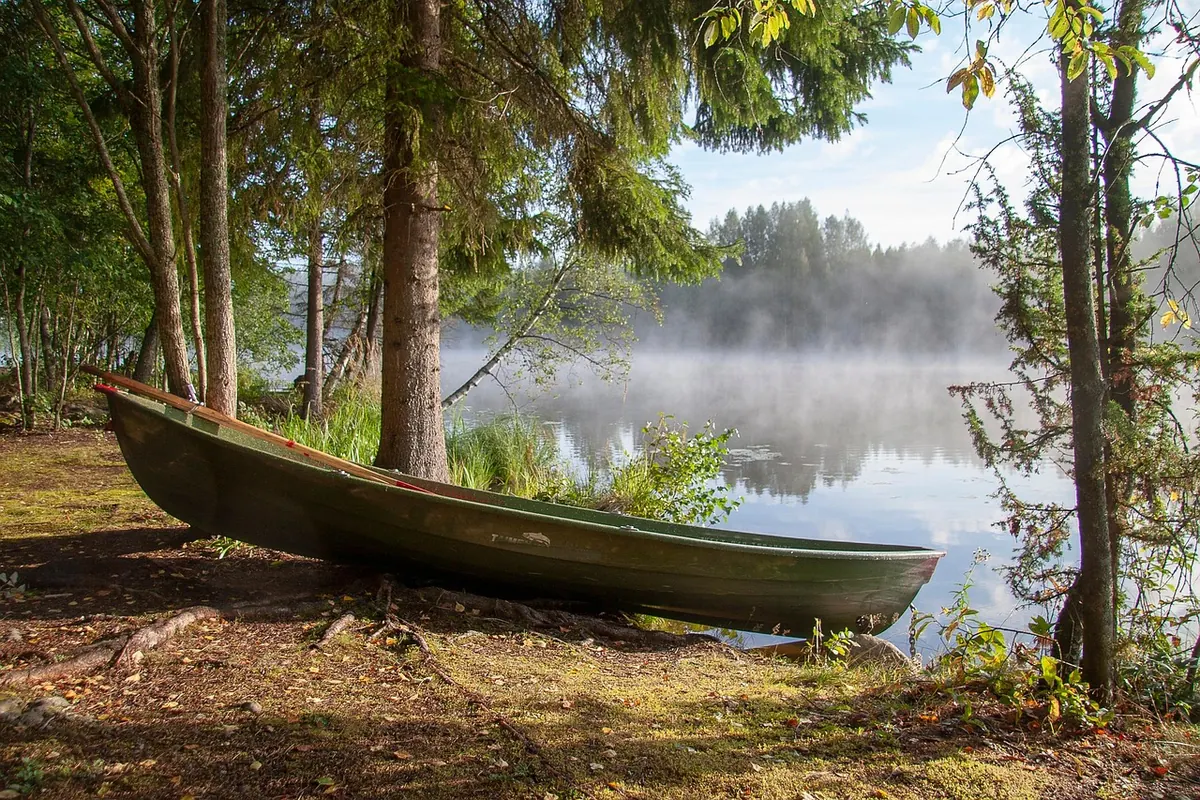
Fog is cloud at ground level — tiny water droplets held in still air, thick enough that you can't see much beyond a kilometre. Mist is the same stuff, thinner: shapes survive a kilometre or two away and colours stay recognisable. Haze is different in kind. It isn't water at all, but fine dry particles — dust, pollen, smoke, traffic and industrial pollution — scattering light over long distances.
The practical distinction: fog and mist are weather you stand inside; haze is something you look through. A quick test is to watch how the world fades. Mist dissolves softly into white. Haze leaves distant hills pale blue-grey but still crisply layered, like sheets of tracing paper stacked up.
How Each One Forms, and When to Chase It
Radiation fog is the photographer's friend. Clear skies, light winds and a long night let the ground lose heat, and the air just above it cools to its dew point. It forms first in low, damp places — river valleys, hollows, the flat fields beside a canal — and it's thickest just before dawn. Advection fog is coastal: warm, moist air drifting over cold sea or cold land, which is why sea frets hang about on North Sea and Channel coasts in spring. Hill fog is simply cloud sitting on a slope, and it can arrive in minutes.
Haze builds the other way round. Warm, dry, settled days let particles accumulate, so long views turn milky through the afternoon. If you want clean distance, shoot early or after rain. If you want layered, painterly ridges, go out at four o'clock on a July afternoon.
Two forecast details are worth checking the night before: wind speed and the gap between air temperature and dew point. A small gap with light wind means fog is likely. Once the sun is up, fog burns off fast — often within half an hour of the first direct light. Be in position early.
What Mist Does to Your Meter
Bright fog is the classic exposure trap. Your camera assumes the scene should average out to mid-grey, so it darkens all that luminous white into dull porridge. You have to overrule it. Start at around +0.7 EV and work upwards; in bright, sunlit mist you may want +1.5 EV or more. Then read the histogram rather than the back screen. You want the bulk of the tones sitting in the upper half, without a cliff edge of clipped pixels on the right. Blown highlights in fog look chalky and rarely recover.
There's a second, opposite approach, and it's often stronger. If you want silhouettes — bare trees, a church tower, a lone walker on a ridge — expose for the mist and let the subject fall to black. Shapes and negative space, no detail at all. Both readings are correct. The mistake is trying to please both in one frame and getting grey nothing.
Watch your white balance, too. Fog takes on whatever colour surrounds it: cool blue before sunrise, peach at first light, green under trees. Shoot RAW and don't scrub all of it out afterwards. A slightly blue mist reads as morning; a neutral one reads as nothing.
Settings That Work in Soft Light
- Exposure compensation first, settings second. Aperture priority with +0.7 to +1.5 EV is a perfectly good way to work. Learn what your own camera does in fog, then adjust.
- Bracket. Three frames at −0.7, 0 and +0.7 EV cover most mornings, and the fog is moving anyway — one frame will have better shapes than the rest.
- ISO 100 and a tripod. Soft light is dim light. A stable tripod lets you hold a small aperture and slow shutter while the mist drifts, which is exactly what you want.
- f/8 to f/11 for front-to-back sharpness through the layers. Open up if you'd rather have a dreamy foreground.
- Long lens for layers, wide lens for atmosphere. A 100–200mm compresses ridgelines into flat bands of tone; a 24mm puts the fog around the viewer.
Haze Is a Different Problem
Because haze is dry particles rather than droplets, it scatters short wavelengths and pushes distant hills towards blue. That's why a summer view of a mountain range looks like a watercolour. It isn't a fault — it's aerial perspective, the same device painters have used for centuries to suggest distance.
Use it deliberately. Backlit haze near sunset gives you a visible sun disc and long shadows raking towards you. A telephoto shot of six successive ridges, each paler than the last, is one of the most reliable compositions in landscape photography, and almost all of its power comes from the haze you'd otherwise be tempted to delete.
A polarising filter will cut some of the scattered light when the sun is at right angles to your subject, deepening skies and cleaning up distance. It does little when you shoot straight into the light. Be wary of the dehaze slider in editing software: pulled hard, it leaves halos along ridgelines and grey, crunchy shadows. A small black-point adjustment, a shallow S-curve and a touch of local contrast usually serve better. Leave some haze in the frame.